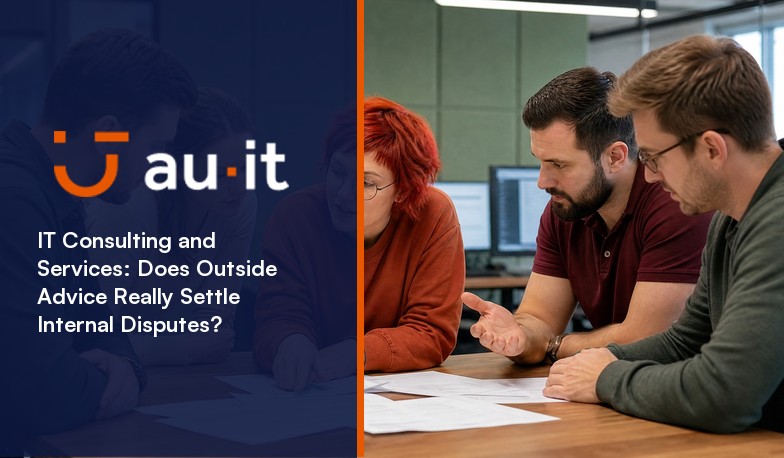
Discover how IT consulting and services can falter without clear internal accountability. Learn why alignment is key to effective consulting outcomes.

November 18, 2026
Bringing in a consulting firm before your team agrees on IT decision-makers often adds confusion and cost, not clarity. Unresolved internal disputes can stall the very progress you hoped to achieve with outside help.
Picture a mid-sized firm bringing in an outside consultant to fix a tangled IT setup, only to watch three department heads argue over whose sign-off actually matters. The consultant's advice sits untouched for weeks.
That scenario points to a problem worth naming plainly: when internal accountability is missing, external IT advice often leads to more debate instead of real progress.
Many businesses turn to consultants hoping for a fresh perspective or a way out of confusion. Yet without agreement on who owns IT decisions, even the sharpest advice can get lost in the shuffle, sitting in an inbox while the people meant to act on it wait for someone else to move first.
So before any investment in outside expertise, it's worth understanding how unresolved internal roles can turn a consultancy's input into just another voice in the room.

Before an external consultant steps in, the team needs to know who's responsible for IT decisions. This isn't just about job titles - it's about real authority and follow-through, the kind that lets a recommendation actually become a purchase order or a project kickoff. When that's missing, even the most experienced consulting company can't cut through the noise.
A consultant's job is to offer guidance, not referee internal debates, which means that if managers or department heads aren't clear on who leads IT projects, recommendations stall right where they land. Instead of moving forward, the team ends up arguing over whose plan to follow rather than following one.
That same confusion also makes it hard for the consultant to grasp the organisation's true priorities. Without a single point of accountability, they receive mixed signals, and the advice that comes back fits no one's needs precisely because it was built to satisfy everyone at once. The result is more meetings, more opinions, and little actual progress.
In Canberra, where many organisations are growing quickly, this kind of misalignment can be especially costly, since the time and money spent on consulting services add up fast when there's no clear decision-maker ready to act on what's recommended.
Bringing in a consulting firm without first sorting out the internal structure risks more than confusion. It risks paying for advice that never gets used.
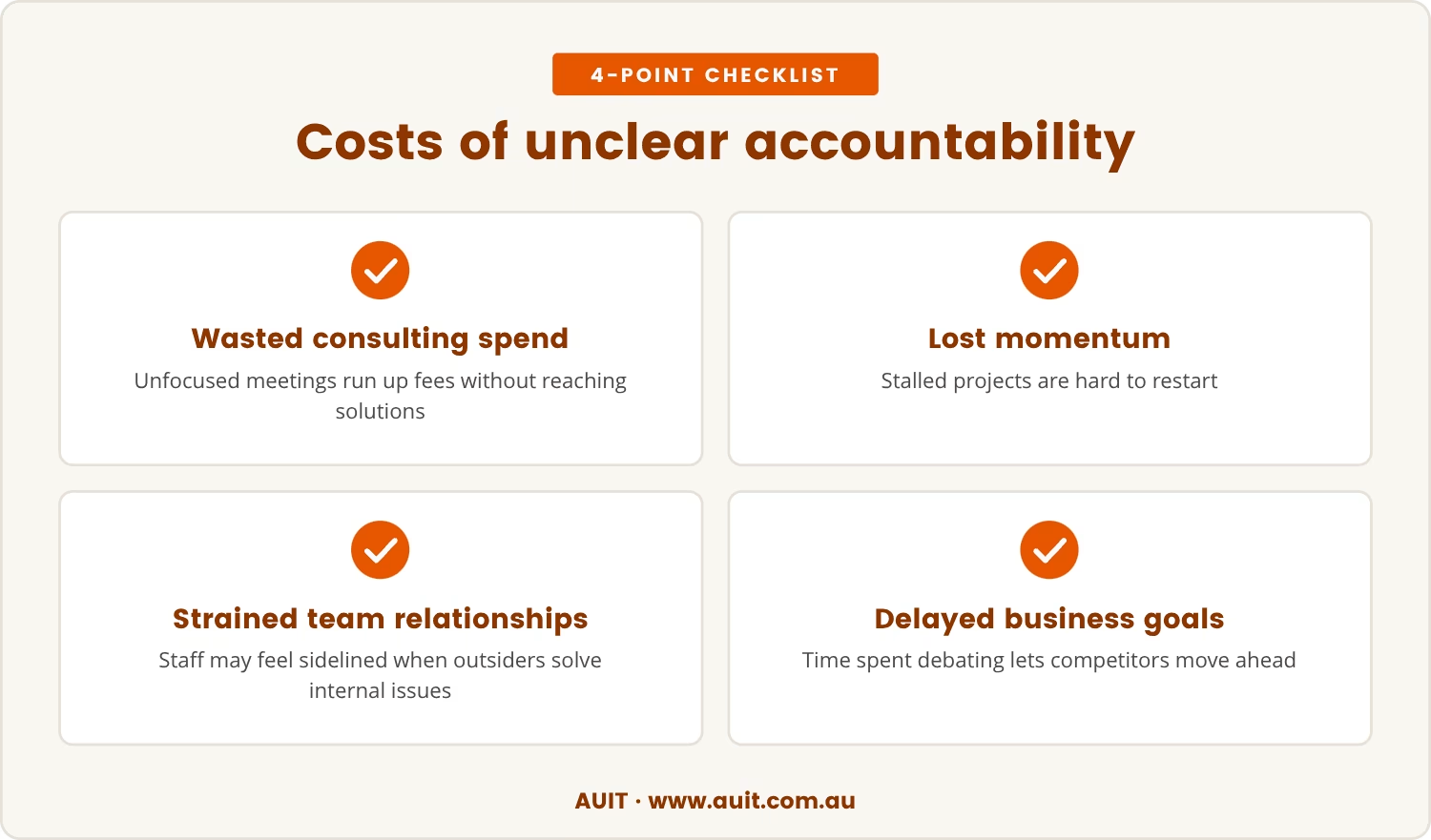
Consultants often charge by the hour or by the project, and if the team can't agree on what it wants, workshops and meetings multiply, running up the bill without closing the gap to a solution. That isn't just wasted money - it's lost momentum, the kind that's hard to recover once a project has stalled.
Unresolved disputes can also wear at relationships within the team. When outside experts are called in to solve problems that should have been handled internally, staff can feel sidelined or ignored, and that tension tends to linger long after the consultants have packed up and left.
In the end, the steepest cost may be the delay in reaching business goals altogether - every week spent debating is a week competitors could spend moving ahead.
There's no doubt that IT consulting and services can be valuable. Their real value, though, shows up only when the team is ready to act on what's advised.
Consultants do their best work when brought in to solve a specific problem or guide a well-defined project, and if the organisation already knows who's in charge of IT decisions, recommendations get put into action quickly. This is where the real benefits appear - faster upgrades, smoother cloud migration, sharper risk management.
But if the team is still debating who gets the final say, even the best consultant can only do so much, because thorough advice means little when no one feels responsible for making it happen.
Before hiring an external expert, it's worth asking: is the team clear on who owns IT decisions? If not, internal alignment deserves attention first.
Consulting services in Australia generally see their role as providing expert guidance rather than settling internal arguments. Here's how that plays out when accountability is unclear.
Consultants will often ask for a single point of contact or decision-maker before a project starts. This heads off mixed messages before they take hold.
Written reports and roadmaps are standard practice, making clear what was advised - though no document can force a team to act on it.
Consultants can facilitate workshops to gather input, but they rarely mediate disputes between departments, keeping their focus on the technical side throughout.
Spotting a lack of accountability, consultants will note it as a risk; fixing it is left to the leadership team.
When a project stalls on internal disagreement, many consulting firms will pause or end the engagement until the team is ready to proceed.
Given how much rides on internal clarity, it helps to check for warning signs before signing a contract:
Recognising more than one of these is a fair signal that internal alignment deserves attention before outside help enters the picture.
With those warning signs in mind, a few steps beforehand set the team up for success.
Start by clearly defining who is responsible for IT decisions - a CIO, an IT manager, or a cross-functional team - as long as it's explicit and understood by everyone involved.
From there, make sure business goals are clear and shared across departments, since consultants can help a business reach its goals only once everyone agrees on what those goals are.
It also helps to document current IT challenges and priorities, which lets a consultant focus advice on what matters most rather than getting pulled into internal debates.
Finally, communicate openly with the team about why outside help is being considered. When staff understand the purpose and the process, they're more likely to back the changes that follow.
The promise of a consultant's roadmap is appealing, but it only works when the team is ready to follow it - without clear accountability, the risk is paying for plans that never leave the page.
Focusing on internal alignment first gives any future consulting engagement its best chance of success, while also sidestepping the frustration and cost of stalled projects and unresolved disputes.
Sorting out who owns IT decisions isn't always easy, but it's the foundation for any meaningful progress - whether or not a consultant is involved.

If you’re running a business with 20 to 100 users, you might be weighing up whether to bring in outside IT help or focus on getting your team aligned first. At AUIT, we understand how easy it is to overlook internal roles when you’re eager for progress.
We invite you to see how we approach these challenges—starting with a conversation about your current setup and what’s holding you back. Let’s talk about what real clarity could mean for your next IT project.
Sign up for a contract with AUIT and you’ll receive a free laptop valued at $2,500, plus a $4,000 cybersecurity assessment at no extra cost.
Claim your free laptop and assessment
A clear decision-maker for IT, well-defined business goals, and agreement on desired outcomes are the signs of readiness. If roles and responsibilities are still being debated, resolving those first makes more sense than bringing in outside advice.
Most consulting companies will flag the lack of accountability as a risk and may pause work until it's resolved. They can offer recommendations, but they won't mediate internal disputes or make decisions on anyone's behalf.
Managed IT services support day-to-day technology needs well, but they work best once the team already knows who is responsible for IT decisions. They're not a substitute for internal clarity about roles and responsibilities.
A consultant is usually an individual expert, while a consulting firm is a team or company offering a range of services. Both can provide valuable advice, but neither replaces the need for clear internal accountability.
Agreement on project goals, roles, and decision-making authority before engaging a consultancy is the surest way to avoid delays. It keeps the project moving smoothly and makes the most of the investment involved.