Discover how human behavior impacts cybersecurity best practices and why security awareness training is essential for effective defense against threats.

November 12, 2026
A business that skips security awareness training can end up weakening its own multi-factor authentication, as staff often find ways around prompts they do not understand. Strong technical defences alone can create a false sense of safety when the human element is ignored.
It is widely assumed that cybersecurity best practices fail at the technical layer—a weak firewall, an unpatched server, an outdated tool. In practice, the failure point is usually human, and the damage rarely stays contained to one system.
A missed detail can ripple through a business, triggering downtime, lost data and recovery work that drags on for weeks. The cost is not always obvious at first, which is exactly why it tends to compound before anyone notices. A strong technical setup is only as dependable as the people operating it day to day, since even the most advanced defences can be undone by one person acting on an instruction they never fully understood. A common blind spot is how staff respond to security prompts they find confusing or simply disruptive to their workflow.
Every business needs to protect sensitive data and keep attackers out, which is why tools like multi-factor authentication (MFA), regular software updates, and secure passwords exist in the first place. Yet none of these tools work on their own—they depend entirely on people knowing how and why to use them properly. Skip security awareness training, and those same defences quietly become weak spots instead. The rest of this article explains how that shift happens, and what can be done to stop it.

Many businesses invest in modern security measures on the assumption that technology alone will keep threats at bay. The real challenge, though, tends to show up not in the tools themselves but in how people respond to them. When users are not comfortable with a new security step, they look for shortcuts around it rather than through it.
Take MFA rolled out without a clear explanation: staff often see the extra login step as a hassle rather than a safeguard. Some will try to bypass prompts, reuse codes, or share authentication devices to save a minute here and there. Each of these small habits quietly undermines the very defence they were meant to support.
This goes beyond convenience. When employees do not understand the reason behind a security measure, they are more likely to ignore it or route around it, and over time those small workarounds stack up into real gaps. The lesson follows naturally: technology and human behaviour are deeply linked, and ignoring one side of that equation leaves a business exposed no matter how much gets spent on the other.
Multi-factor authentication is widely regarded as a reliable defence against unauthorised access, working by requiring two or more pieces of evidence—a password plus a code from a phone, say—before a login is allowed through. That reliability, though, still depends on the person holding the phone.
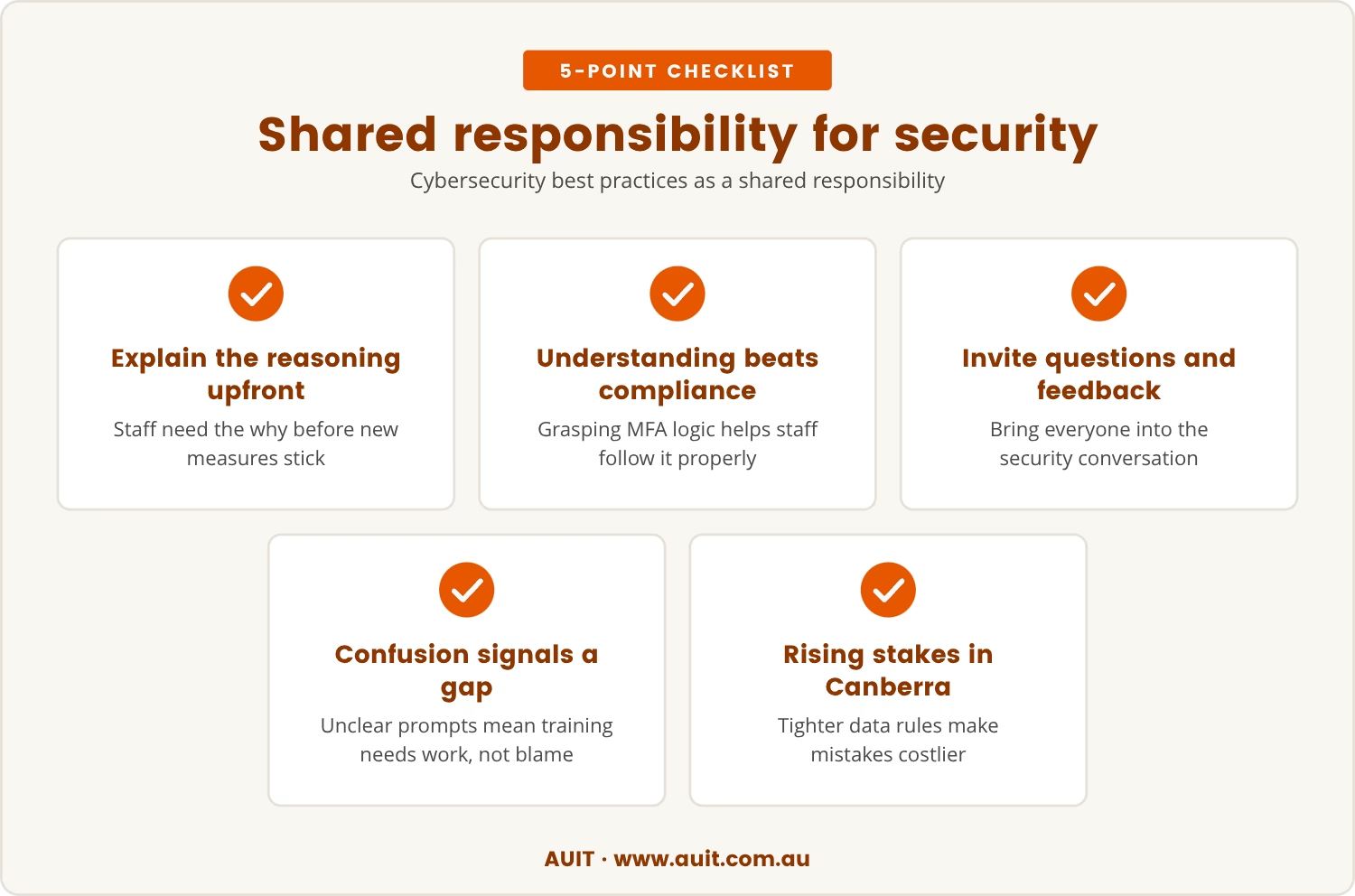
If staff do not understand why MFA matters, they tend to treat it as an obstacle rather than a safeguard. Some approve login requests without checking whether they triggered them; others share codes with colleagues just to save a few minutes. These habits develop quietly, especially in busy workplaces, and attackers are well placed to notice and exploit exactly this kind of pattern. A phishing email, for instance, could trick someone into handing over their MFA code, handing the attacker full access despite every technical control sitting in place.
The risk, as a result, is rarely visible on the surface. Systems can appear secure while the real protection underneath is far weaker than it looks, which is precisely why staff training is not a nice-to-have but a core part of any effective cybersecurity strategy.
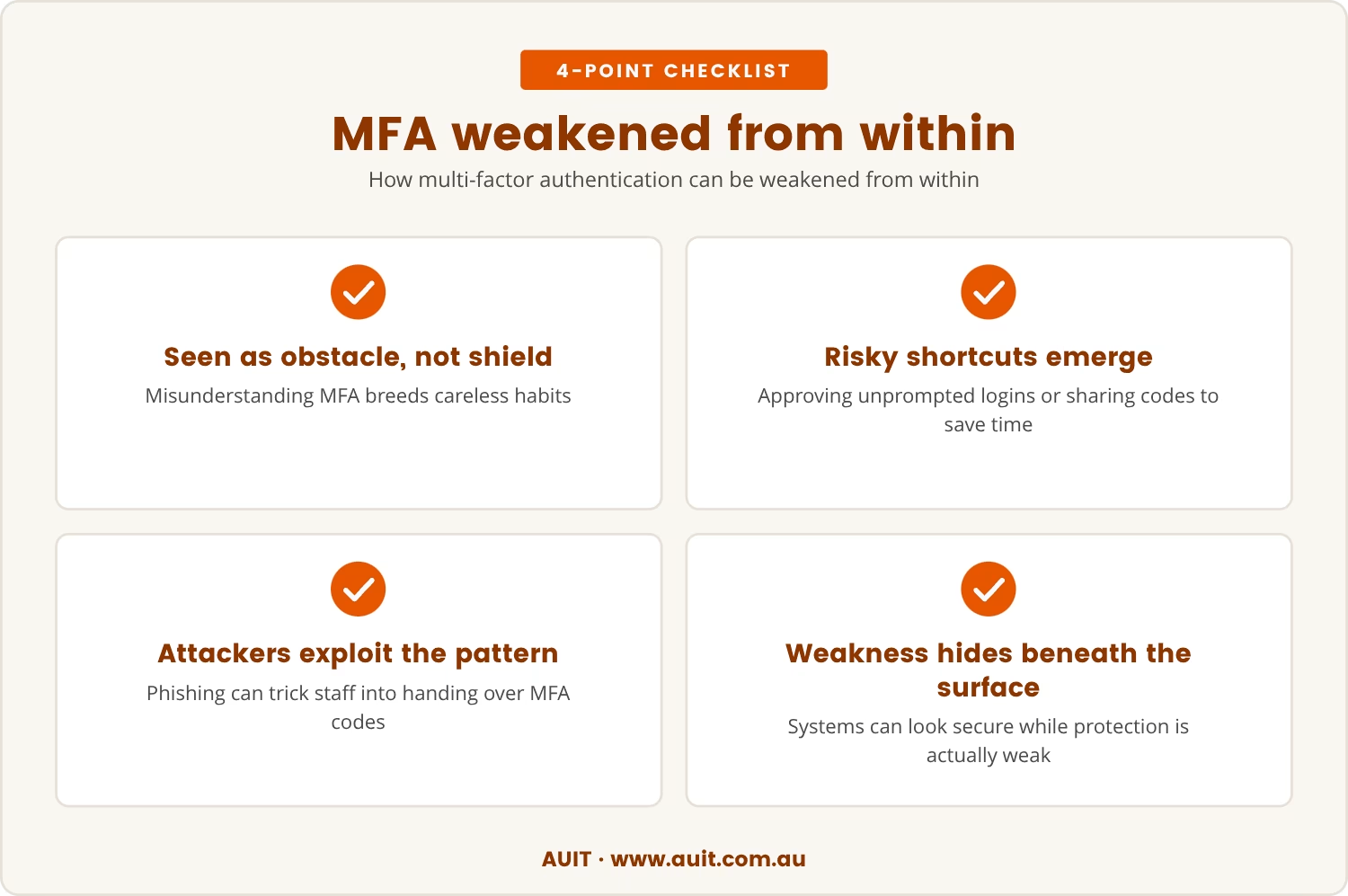
Every business in Canberra faces the same balancing act: keeping defences strong while making sure staff can still do their jobs without friction. Cybersecurity best practices are not a checklist handed to the IT team—they are habits everyone in the business needs to understand and follow.
Because of that, introducing a new security measure means explaining the reasoning behind it from the outset. Staff who understand why a step exists are far more likely to follow it correctly, and this matters especially for something like MFA, which can feel repetitive or confusing before the logic clicks.
A shared approach means bringing everyone into the conversation, actively encouraging questions and feedback. If someone finds a prompt unclear, that is a signal the training or instructions need work, not a sign of carelessness on their part. The goal is understanding, not just compliance.
For Canberra businesses, this shared responsibility carries extra weight. Regulations and expectations around data protection keep rising, and a single mistake can carry serious consequences. Building a culture of awareness is what keeps defences strong from the inside out.
Staff who are not comfortable with security measures tend to find creative ways around them, and these workarounds can be hard to spot even though their impact on the business is real. The patterns below are among the most common.
Some users fall into the habit of clicking "approve" on every authentication request, even ones they did not trigger themselves. That habit makes it far easier for an attacker to slip through unnoticed.
To save time, staff sometimes share a phone or token used for MFA. Doing so defeats the purpose of individual verification and widens the exposure across the whole system.
When staff do not understand why unique passwords matter, they often reuse the same one across multiple systems. If one account is breached, every other account sharing that password becomes vulnerable too.
Pop-up alerts are sometimes dismissed without being read at all. That habit can mean missing the early signs of a phishing or malware attempt.
To avoid forgetting them, some people write sensitive credentials down and leave them somewhere accessible. That turns a desk or drawer into an easy target for anyone with physical access.
Security awareness training is not a box-ticking exercise; it is what changes how people think and act when a security decision lands in front of them. When staff understand both the risk and the reasoning behind each step, they are far less likely to reach for a shortcut.
For that reason, training works best when it is practical and ongoing rather than a one-off session. It should cover real-world scenarios—spotting a phishing email, knowing what to do if an MFA prompt appears unexpectedly—and actively invite staff to ask questions or flag anything that feels off.
Over time, this approach builds habits that reinforce the technical defences already in place. Staff grow more confident and proactive, which cuts down on accidental mistakes, and the result is a business where security sits inside the culture rather than existing as a separate set of rules.
A proactive approach to cybersecurity means staying ahead of threats rather than only reacting once something has gone wrong, and clear communication is what makes that possible. Explaining the "why" behind each security measure makes it far easier for staff to do the right thing without having to be told twice.
Regular updates and reminders keep security top of mind in a way a single training session never can. Sharing examples of common threats, and showing how the various defences work together makes the system legible instead of mysterious. Everyone has a role in it, from the newest hire to the most experienced manager.
When was the last time training materials were reviewed, or staff use of security tools actually checked? Small shifts in communication can make a outsized difference to how well those defences hold up over time.
The strongest technical controls can be quietly undone by untrained staff, and when people find ways around prompts they do not understand, a business is left with a false sense of safety. That risk rarely announces itself until something has already gone wrong.
Investing in security awareness training, then, is not only about compliance—it is about protecting a business from the inside out. Making sure everyone knows how and why to use the defences already in place turns potential weak points into genuine strengths.

Many businesses with 20 to 100 users have invested in strong technical controls but still worry about gaps caused by staff habits. At AUIT, we understand how easy it is for security measures to be weakened from within.
If you want to see how we approach security awareness and technical defences together, let us show you what a practical, people-focused strategy looks like for your business.
Sign up for a contract and you will receive a free laptop valued at $2,500 plus a $4,000 cybersecurity assessment, helping you close the gaps that matter most.
Claim your free laptop and assessment
Watch for repeated failed login attempts, staff sharing devices, or users approving MFA prompts they did not request themselves. Reviewing authentication logs regularly, alongside open conversations with staff about their experience, helps surface issues before they escalate.
Short, practical sessions focused on real risks—phishing, password safety—tend to land better than broad theory, especially when the examples are drawn from situations relevant to the business itself. Ongoing reminders and refreshers keep the lessons from fading.
Technical measures like MFA and strong passwords only work when users follow the correct steps behind them. Without understanding or trust in those processes, staff are more likely to ignore them or find ways around them, weakening the defence as a whole.
Security measures are worth reviewing at least once a year, and again whenever new technology or processes are introduced. Regular updates keep defences effective against emerging threats and keep staff confident using them.
An incident response plan should set out how to detect, report and respond to security incidents, including who is responsible for each step. Staff need to know how to access the plan and understand exactly what their own role is if something goes wrong.